
Hello and welcome back to this month’s blog series on unemployment. Moving on from last week’s exploration into the data and statistics, this week’s focus is on public policy. In this blog, we will explore policies that aim to decrease unemployment.
Decreasing Unemployment: A Mathematical Perspective
Last week, we explored the data on Kentucky’s unemployment rate and how it is actually defined. Seeing as it is defined as the percentage of employed people divided by the labor force, the mathematical way to decrease this is to either: (1) decrease the amount of people that are considered “unemployed” or (2) increase the amount of people who are a part of the labor force. As a reminder, someone is considered “unemployed” if they do not have a job, even after looking for a job during the past four weeks. In this blog, we will consider policy that primarily aims to decrease the amount of people who are considered “unemployed”.
As discussed in the book Freakonomics by Stephen J. Dubner and Steven Levitt, policies largely seek to give people incentives for certain behaviors. In the case of decreasing the number of unemployed people, this can come in two forms: (1) incentivizing people to become more employable or (2) incentivizing businesses to hire these people. We will explore both of these approaches.
Policies That Aim to Make the Unemployed More “Employable”

resources for those in Eastern
Kentucky
- Training Programs:
Government-funded training programs can often teach unemployed people marketable skills. In a world that grows more reliant on technology by the day, education for certain trades, like software and coding, is pivotal for marketing oneself as employable to a company. These programs can come through non-profits with public funds, like SOAR (Shaping Our Appalachian Region). It can also come through publicly run programs, like the Job Corps, which offers hands-on training to low-income individuals between the ages of 16 and 24 years old. These programs help bridge the gap between employers and the workforce.
- Job Centers:
Known nationally as American Job Centers, or Kentucky Career Centers in Kentucky, the government sponsors and prepares resources for the unemployed. This includes help to improve their resumes, prepare for interviews, and gain access to job banks. These resources are meant to provide those looking for a job with practical tools in the job-search process. - Unemployment Insurance:
To prevent the unemployed from falling into poverty while they look for employment, unemployment insurance is a program that is funded jointly by both the state and federal governments. This program allows people to receive funds from the government that are a portion of what they would earn while they are working. According to EconPort, this can increase unemployment for a short time because it removes the full incentive for people to continue looking for work.
Policies That Aim to Help Businesses Hire Employees
- Decreased Tax Rates:
One way that legislature aims to help businesses grow in number of employees is by cutting tax rates. As tax rates decrease, consumers have more money to spend, which leads to higher profits for businesses. These higher profits can then be invested into hiring new employees and the number of people who are unemployed can decrease. According to Investopedia, these increased levels of disposable income and consumption lead to a higher gross domestic product (GDP). - Decreased Interest Rates:
Decreasing interest rates allows more people to borrow money, which can then be invested into the economy. This exchange creates a similar effect as decreasing taxes, because both lead to more consumption. This in turn allows businesses to hire more people with their increased profits. - Tax-Exempt Hiring Practices:
There are several policies that have enabled companies to become exempt from certain taxes if they hire people who would often otherwise be considered unemployed. For example, the HIRE Act (Hiring Incentives to Restore Employment) incentivizes the hiring of people who are directly within the “unemployed” group. Other acts like the Work Opportunity Tax Credit incentivizes companies to hire from targeted groups, like veterans.
Key Points
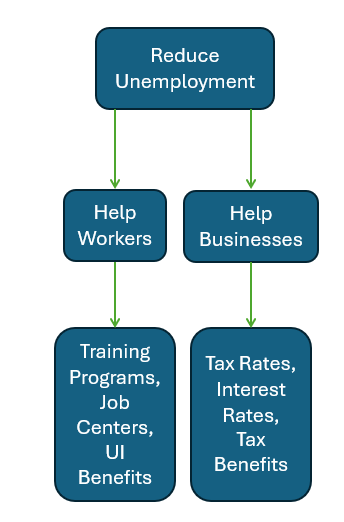
- In order to decrease the rate of unemployment, either the amount of unemployed people must decrease or the total labor force must increase. To accomplish these goals, policies aim to incentivize people to take specific actions.
- Policies aimed at decreasing the amount of unemployed people can either:
(1) Help the unemployed become more employable (Ex. training programs, job centers, unemployment insurance)
(2) Help businesses hire more employees (Ex. cutting tax rates, cutting interest rates, tax-exempt hiring practices)
Overall, there are several ways that policymakers can aim to lower the unemployment rate. Specifically, they can incentivize both the unemployed and businesses to capitalize on and to create job opportunities for the population.
Sources
EconPort- Public Policies Affecting Unemployment
Investopedia- How Policymakers Can Reduce Cyclical Unemployment
Pingback: Hiring and Incentives: How Businesses View Unemployment - colinhornforky.com