
With contributions from Danna Barnett
Welcome to the first segment of our first monthly blog series! This week we are breaking down on of the most commonly cited- and misunderstood- economic indicators: the unemployment rate. Throughout the month of April, we will analyze the unemployment rate from several different angles. We will also gain different perspectives of Kentuckians and how they interact with the unemployment rate- from communities to businesses to policymakers.
Unemployment Rate: Defined.
We hear this phrase– unemployment rate– quite often from politicians and economists alike. What does this phrase actually mean? The Bureau of Labor Statistics defines the unemployment rate as “the number of unemployed people as a percentage of the labor force”. Let’s break this down a bit further..
1. Unemployed people: defined as people who “do not have a job, have actively looked for work in the prior 4 weeks, and are currently available for work”
a. “Job” is defined as work for pay or for profit (or unpaid work for a family business)
b. “Actively looked” means searching for a job through various means, such as contacting employers or attending job fairs
2. Labor Force: defined as “the sum of the employed and the unemployed”
a. “Employed” means performing a job for pay or profit, full-time or part-time
Overall, the unemployment rate represents the percentage of people in the labor force who are looking for a job but cannot find one.
Where Does Kentucky Stand With Unemployment Rate?
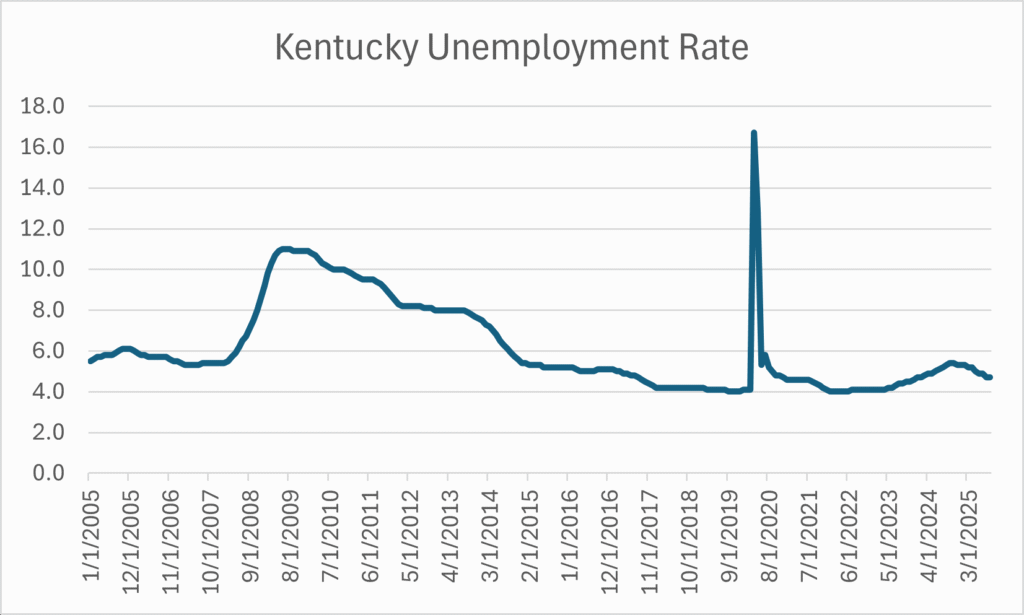
The graph above shows the trend of Kentucky’s unemployment rate from 2005 to 2025. While this data is complex, there are several key insights to note:
1. The Great Recession: Clearly, there was a great increase in 2008 due to the financial crisis at the time. During the summer of 2009, Kentucky’s unemployment rate hit a local maximum of the recession at 11%. By 2015, the unemployment rate was back under 5.5% and by 2019 it was all the way down to 4%.
2. COVID Pandemic: Over the course of twenty years, this was the period of the highest unemployment rate for Kentucky. From March to April in 2020, Kentucky’s unemployment rate skyrocketed from 4.1% to 16.7%. However, by June of that year, it was back to 5.3% and all the way down to 4% at the beginning of 2022. This sharp spike and recovery shows how short-term events can dramatically change the unemployment rate, but it can also recover quickly.
3. Recent Movement: Since the beginning of 2022, the unemployment rate in Kentucky increased to 5.4% in November 2024. However, this was followed by a downward trend to 4.5% in December 2025. This is the most recent data available (as of February 2026).
Common Misconceptions
Perhaps the largest piece of the puzzle that is missing with the unemployment rate is the people who are not looking for work, as mentioned by Danna Barnett, Director of Entrepreneurship at SOAR (Shaping Our Appalachian Region). As she notes, this could be for a variety of reasons, whether they just gave up looking or had a specific reason to, like to stay home and care for children. Also excluded from this group are students and retirees. As a result, the data on unemployment does not fully represent the health of a community’s workforce. This is why an indicator like prime-age employment can give a more specific view of who is actually working. Also, population totals can tell a broader view of the working demographics.
Perhaps the largest piece of the puzzle that is missing with the unemployment rate is the people who are not looking for work
Another common misconception is that being “employed” means having a full-time job that pays a living wage. Both part-time and full-time work make up the “employed” population. For this reason, the unemployment rate does not fully capture those who may be struggling to make ends meet. For this reason, figures like median weekly wages and quality of life can give a more holistic view of the economic health of a region.
In other words, a low unemployment rate does not always indicate a strong economy- it just means that most people who are looking for work are able to find it.
Key Points
- Unemployment Rate = (Unemployed)/(Labor Force)
- Kentucky’s Unemployment Rate Key Trends: Upward During the Great Recession (2008-2009), Upward During COVID (2020-2022), Recent Upward Trend (2022-2024) and Downward Trend (2024-2025)
- Unemployment Rate Does Not Fully Capture:
– Who has stopped looking for work
– Whether employment is full-time or part-time
– Whether these jobs provide a livable wage
Overall, the unemployment rate can be a helpful tool in viewing the economic state of a region. However, it also falls short in some ways, which is why it is good to garner other statistics as well. This gives a more holistic picture. Nonetheless, the unemployment rate is a useful starting point, although it is not the full picture. When combined with other key data points, a clearer view of Kentucky’s economic health emerges.
Sources
U.S Bureau of Labor Statistics- How the Government Measures Unemployment
U.S. Bureau of Labor Statistics (LAUS Data)